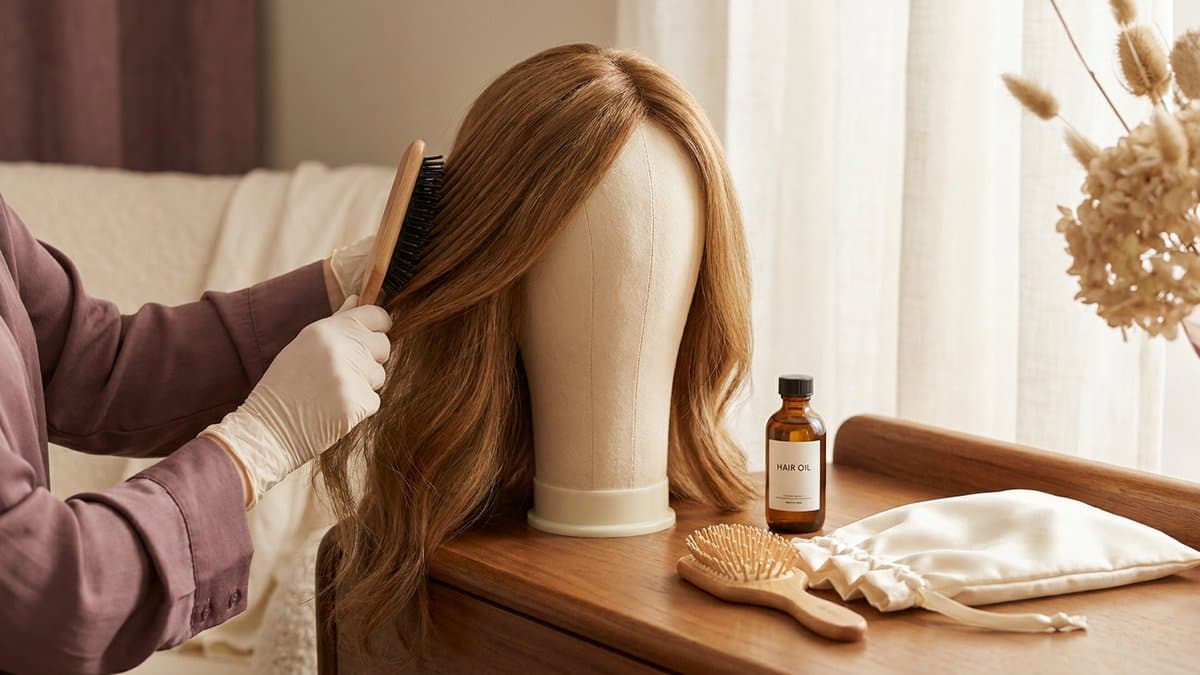
Why wig hair needs more than biological hair
Your scalp produces sebum that coats every strand from root to tip. A wig's hair never gets that. The result: the same quality of hair that would thrive on a head dries out, tangles and splits on a cap unless you replace the moisture externally. Every rule below follows from that one fact. If you have not bought your unit yet, Human Hair Wigs covers what to look for, and our seller reviews rank where to buy.
Washing
Frequency: every 7 to 14 days of actual wear. Product buildup (adhesive residue near the lace, styling products) is the trigger; if you wear glueless and use little product, lean toward the longer end.
Routine:
- Detangle fully before wetting, because water tightens existing tangles.
- Rinse in lukewarm water, flowing downward, never piled on top of the head.
- Sulfate-free shampoo, diluted in water, applied in downward strokes. No circular scrubbing; it mats the hair and stresses the knots.
- Rinse, then conditioner or mask from mid-lengths to ends. On lace caps, keep heavy conditioner off the lace itself, since it loosens knots over time.
- Cool final rinse, pat dry with a towel, and air-dry on a wig stand. If you must blow-dry, low heat and keep it moving.
Moisture between washes
- A leave-in conditioner spray after each wear day keeps strands supple.
- Light oil (argan is the community default) on ends every few days reduces splitting.
- Deep-conditioning mask every 3 to 4 washes for units you wear daily.
Heat discipline
Human hair wigs take heat tools, but every hot pass is borrowed lifespan:
- Always heat protectant spray first.
- Keep tools at or below 180°C / 350°F for daily styling.
- Straighten or curl in one slow pass rather than repeated passes.
- Curly units: refresh curls with flexi-rods or braids overnight instead of re-curling with heat.
The knot problem: shedding prevention
Shedding on a wig is almost always knots failing, not hair breaking. Protect the knots:
- Never comb from root downward through resistance; work ends first.
- If you wear lace units with adhesive, remove adhesive with proper solvent, never peel.
- A knot sealer applied to the underside of lace (by you or a stylist) meaningfully extends lace unit life.
- Wash with the cap right-side out, not inverted and tangled.
Storage and rotation
- Wig stand for daily storage; a canvas head holds shape best for lace units.
- Rotate at least two units if you wear daily. Lifespan more than doubles because each unit gets recovery time and less cumulative friction.
- Travel in a satin-lined wig bag, hair loosely braided or pinned.
When to retire a unit
Persistent dryness after deep conditioning, visible thinning at the part or hairline (knot loss), and tangles that return within hours of detangling are the three end-stage signs. A unit at that point can still serve as a backup or styling practice head, but not as your daily face.
Sources
- r/wigs long-term wear routines and product reports.
- Wikipedia: Wig for construction terms used in care advice.